Why is this toy so expensive on Amazon, and will the price come down?
By Britton Jewell · Last updated
Short answer: a toy usually costs more than you expect for one of two reasons. Either the retail price itself went up, or the toy sold out at major retailers and the copies that are left are being sold by third-party sellers at whatever buyers will pay. You can usually tell which in a minute: check who is selling it on the listing, then look at its price history in a free tool like Keepa or CamelCamelCamel. A sold-out toy's price often comes back down if it gets reprinted or restocked in large numbers. A higher retail price usually doesn't.
Who wrote this: Britton Jewell, a collectibles reseller who runs BuyHoldCollect. Yes, we sell toys like these. We'll still tell you when the answer is to wait. More about us. We don't sell or hold either figure in the examples below.
The two reasons
The retail price went up. Toy makers raised prices across many lines in 2025, in part because of tariffs on toys made overseas; Mattel told investors it would raise prices on some toys where necessary. In our experience those higher prices have generally stayed. If major retailers list the toy at the same "high" price, that's the new retail price, and waiting probably won't help.
It sold out at retail. When Amazon and other big stores run out, the listings that remain belong to third-party sellers, and the price is set by how many copies are left and how many people still want one. For why some figures sell out while others sit on the pegs, see why some action figures sell out; for the Pokémon-style rush, see why everything is sold out.
Step 1: read the Amazon listing
- Look at "Ships from" and "Sold by" next to the Add to Cart button. "Sold by Amazon" means Amazon's own stock. Any other name is a third-party seller. "Ships from Amazon" with another seller's name means a third-party seller who stores stock in Amazon's warehouses (FBA): fast Prime shipping, but the seller sets the price.
- Open the other offers (the "Other sellers" or "See all buying options" link). One or two sellers at a high price is a thin market; a dozen sellers close together is a settled one.
- "Currently unavailable" means nobody is selling it new on that listing right now. It can come back; see whether a figure gets restocked.
- Read the crossed-out price carefully. Amazon's pricing help page says the List Price is the manufacturer's suggested retail price (MSRP), and the Typical Price is the median price customers paid on Amazon over the past 90 days. On a sold-out toy, the Typical Price can already include the markup, so a "deal" against it can still be well over retail.
Step 2: find the real retail price
Check the maker's own store (Hasbro Pulse, Mattel Creations) and one or two other big retailers like Target or Walmart. If they have it in stock at a lower price, that's retail and you've found your answer. If they're all sold out, the maker's product page or a toy news post from release week usually still shows the original price. Don't trust a price tracker's "list price" on its own: when we checked, CamelCamelCamel's product details showed a list price of $139.99 for the Green Ranger figure below, which launched at $22.99.
Step 3: read the price history
Keepa and CamelCamelCamel are both free to look up: paste the Amazon link or search the product name. Each chart shows Amazon's own price and third-party sellers' new price as separate lines, often going back years, and both can email you when the price drops to a number you pick. Keepa also has a browser extension that puts the chart right on the Amazon page. Here's what the patterns look like on two real figures (charts as of ).
Example 1: a sold-out figure that kept climbing
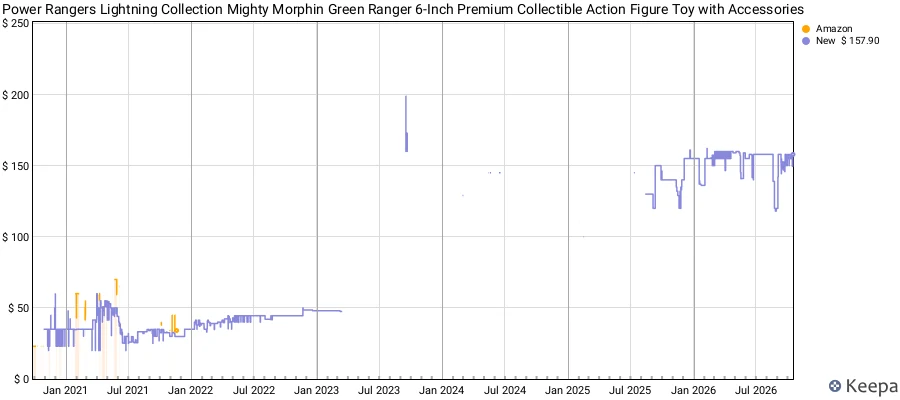
How to read it:
- The orange marks stop in 2021. Amazon sold it on and off, last in November 2021. Every price after that comes from third-party sellers.
- The purple line climbs slowly while sellers drop out. Third-party prices sat around $30–48 through early 2023 as the number of sellers fell from about 40 to two or three.
- The blank stretch is the important part. From early 2023 to mid-2025 there were almost no new offers at all, apart from one brief listing near $200 in late 2023. A gap means nobody was selling, not that the price was zero.
- When it came back, it came back high. Since mid-2025 a handful of sellers have listed it at about $120–160. Nothing on this chart suggests a fall is coming; that would take a reissue or a big restock.
The same figure on CamelCamelCamel
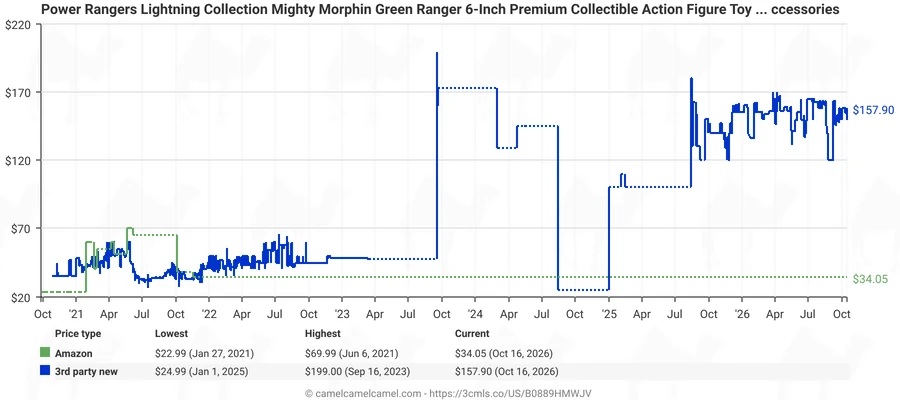
Same data, drawn differently. CamelCamelCamel joins the gaps with dotted lines from the last price it saw, so the empty 2023–2025 stretch looks like a price instead of a blank. Its chart also lists $34.05 as Amazon's "current" price, but that's the last price Amazon had in 2021; the table on CamelCamelCamel's product page shows no current Amazon price. Our rule: a dotted line is no real price. Check which stretches are solid before you trust a number, and compare with Keepa when it matters.
Example 2: an exclusive whose early markup didn't last
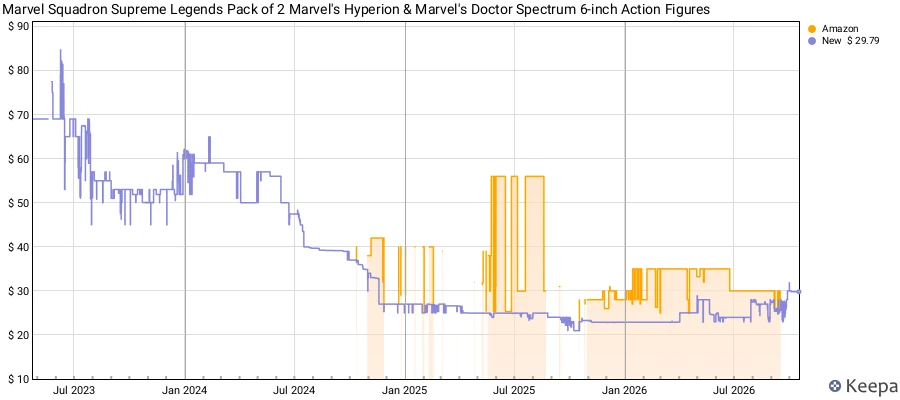
This two-pack was a Fan Channel exclusive (The Figure In Question) at about $49.99 (Laughing Place), released around July 2023. On Amazon it started with one or two third-party sellers at $65–69, briefly above $80. Then more sellers arrived, the price slid for a year, and by late 2024 Amazon itself was selling it. Since 2025 it has mostly sold for $21–30, well under the original retail price. Buyers who paid the early Amazon markup paid $15–35 more than retail for something that got cheaper. Not every exclusive goes this way (see what "exclusive" means), but it does happen.
Patterns to look for
| On the chart | It usually means |
|---|---|
| Amazon's line is steady at the same price other stores charge | That's retail. Waiting rarely helps, apart from sales. |
| Amazon's line stops and the third-party line climbs | Sold-out markup. It may come down with a reissue or restock, or keep climbing. |
| A blank stretch (Keepa) or dotted line (CamelCamelCamel) | Nobody was selling it new. There's no real price for that stretch. |
| The number of sellers rises and the price slides | Supply is catching up. Waiting usually gets a lower price. |
| A high price right after release, with only one or two sellers | An early markup. Check whether specialty stores still have it at retail. |
Step 4: check what it actually sells for
An Amazon asking price is only what one seller hopes to get. To see what buyers really pay, search eBay for the figure and turn on the Sold items filter. Compare totals with shipping included: a cheaper price plus $12 shipping can cost more than a higher price with free shipping. If sold eBay copies go for well under the Amazon price, the Amazon listing is overpriced. For how box condition changes those comparisons, see whether a damaged box lowers the value.
Will the price come back down?
It depends on supply. A reissue usually brings the price back toward retail once the new stock ships, and reissues are usually announced as preorders months ahead. A restock can help, but Amazon doesn't always come back at the regular price. Store and convention exclusives rarely return. Nobody outside the manufacturer can predict a reprint; for how they work and how to hear about one first, see will this action figure be restocked or reprinted?
Should you wait or buy now?
- Buying a gift on a deadline? If there's no reissue preorder listed and the date matters, waiting is a gamble with no guaranteed payoff.
- Is it a mainstream character in a kids' line (a popular superhero, wrestler or die-cast car)? Those are more likely to be restocked or reprinted than collector-only exclusives.
- Is a reissue already listed? If so, waiting usually saves money, as long as you can wait until it ships. Check when the store will charge you for the preorder.
- How big is the premium? A few dollars over retail is rarely worth waiting months for; double the retail price may be.
- Not in a hurry? Set a free price alert in Keepa or CamelCamelCamel at the most you'd pay, and let it tell you if the price gets there.
- Shopping a holiday sale? See how to tell whether a Black Friday toy deal is real.
Quick answers
Why is this toy so expensive on Amazon?
Usually one of two reasons. Either the retail price itself went up, or the toy sold out at major retailers and the copies that are left are being sold by third-party sellers at whatever buyers will pay. Check who the seller is on the listing and look at the price history in a free tool like Keepa or CamelCamelCamel to tell which.
Why is a toy more expensive on Amazon than at Target or Walmart?
Usually because Amazon itself is out of stock and the listing is being filled by third-party sellers, who set their own prices. If Target or Walmart has it at the regular price, that's the retail price. If they're sold out too, the Amazon price is a sold-out markup.
How do I see a toy's price history on Amazon?
Paste the Amazon link or the product name into Keepa or CamelCamelCamel. Both are free to look up and show separate lines for Amazon's own price and third-party sellers' prices going back years. Keepa also has a browser extension that puts the chart on the Amazon page.
What does a gap or dotted line mean on a price chart?
Usually that nobody was selling it new on Amazon at that time. Keepa leaves the stretch blank. CamelCamelCamel draws a dotted line from the last price it saw, and its chart can still show that old price as current. Treat both as no real price, not as a price someone paid.
Will the price of a sold-out toy come back down?
Sometimes. If the manufacturer reprints or reissues it, the price usually falls back toward retail when the new stock arrives. A retailer restock can also help, but restock prices aren't guaranteed to be at retail. Retailer and convention exclusives rarely come back, though some do reach more stores later and get cheaper.
New to terms like chase, HTF or reissue? See our collector and reseller glossary.
Related: Is that Black Friday toy deal real? · Will this action figure be restocked or reprinted? · Why do some figures sell out and others peg-warm? · What does "exclusive" mean on a figure? · How do tariffs affect toy prices? · When do preorders get charged?
Get new pages when they're published
Prices and policies change. This page is general information, not financial advice. "In our experience" statements reflect one reseller's observations, not official retailer or manufacturer policy. Chart images are from Keepa and CamelCamelCamel, captured October 16, 2026; BuyHoldCollect isn't affiliated with either.